
26 November 2025 Back to News
On this day: the era of telegraphy begins
"Yesterday a pleasant ceremony was held in Piraeus in the presence of Their Majesties M.M. of the King and Queen, the Ministry, the Presiding Officers, and the Diplomatic Corps, and a large crowd, the electric cable was laid, which will connect Piraeus with Syros," wrote the newspaper Aion on November 27, 1858, announcing the big news about the introduction of the electric telegraph in Greece.
Until then, the country had been isolated, and the only means of communication with the outside world was by sea. For the Greek government, the adoption of the telegraph was a means of direct communication between Greece and Central and Western Europe, but also a diplomatic message that the new Greek state was now on the path to modernization. At the same time, aerial telegraph lines began to be installed throughout the country.
On October 28, 1858, the English company Newall & Co Elba agreed with the government to purchase and install an underwater cable, consisting of an electric wire, which would connect Piraeus with Ermoupoli, the country's most important commercial port. The same steamship that had been used to install important submarine telegraph lines at the time would be used to lay the cable, and the Greek side agreed to pay £176 per nautical mile.
The news was received with enthusiasm by the press, as evidenced by the newspapers of the time. Aion congratulated the government on the project, while commenting on the delay in the arrival of the telegraph: "We must congratulate the government for completing such a beneficial project, because Greece's exclusion from the telegraph network was truly unjustifiable."
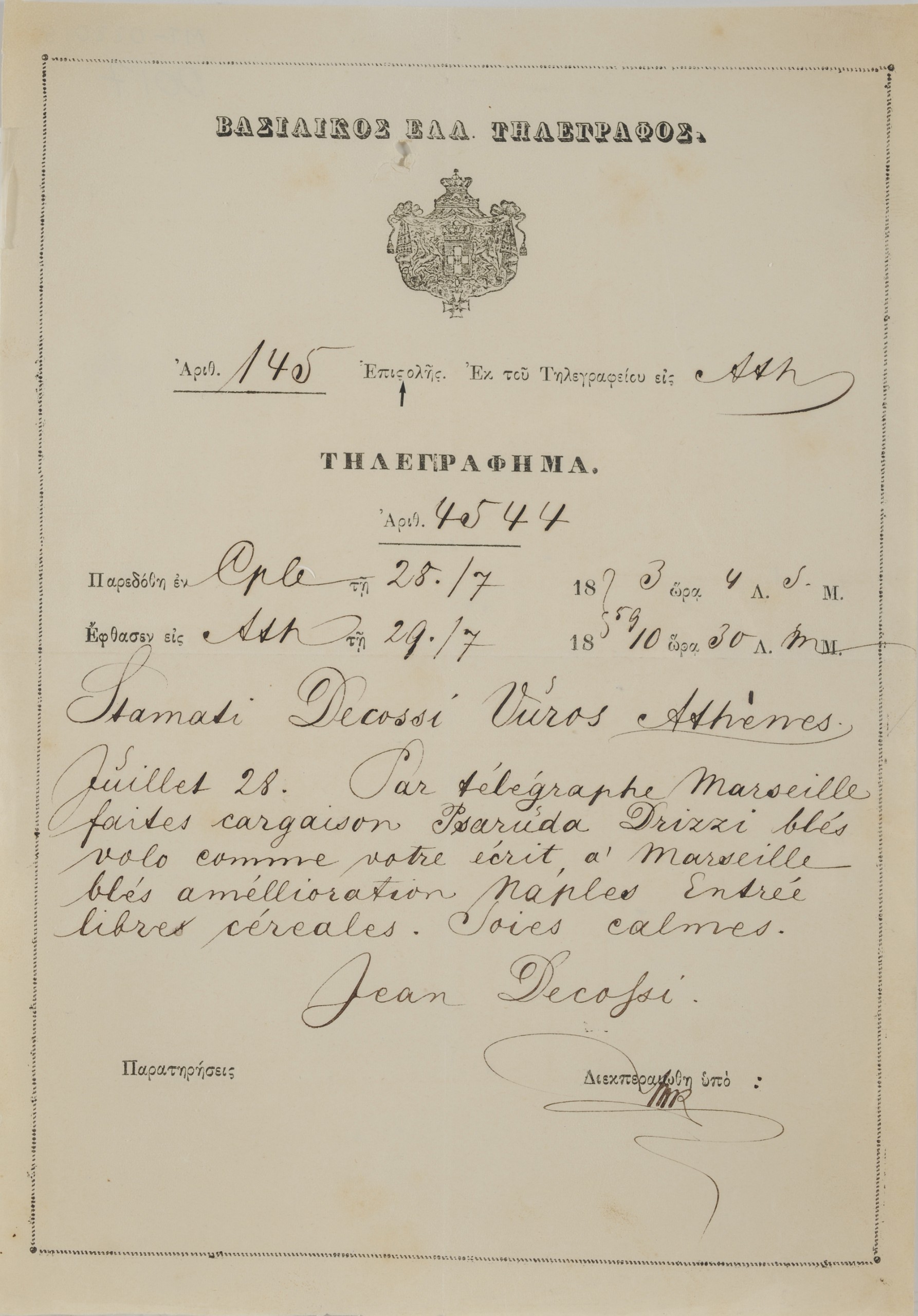
By early December 1858, the cable had been installed and test signals had been exchanged, while in 1859 the first telegrams began to be sent by the state telegraph service. Among them was a commercial telegram, which is now kept in the Museum's telegram collection. This telegram was sent from Constantinople on July 28, 1859, at 3:30 p.m., and was delivered to Athens after 7 hours and 27 minutes, highlighting the impressive speed offered by the new means of communication. In less than a day, information that would previously have taken days or even weeks to arrive by sea could now be transmitted instantly, marking Greece's effective integration into the international telegraph network.