
12 December 2025 Back to News
December 12, 1901: When radio waves crossed the Atlantic
"It was a wild, harsh day; at the base of the cliff, three hundred feet below us, a frozen sea raged. Towards the ocean, through the mist, I could faintly make out the outline of Cape Spear, the easternmost point of the North American continent, while beyond it stretched the endless ocean, nearly two thousand miles between me and the British shores. The critical moment had arrived, for which the path had been prepared after six years of hard and relentless work, despite all kinds of criticism and numerous attempts to discourage me and divert me from my ultimate goal..."
This is how Guglielmo Marconi begins in his autobiography the description of the first transatlantic radio signal transmission. The event, which took place on December 12, 1901, marks a milestone in the history of telecommunications, as it signaled the transition to a new era of global connectivity. That morning, Marconi, stationed in St. John’s, Newfoundland (present-day Canada), received the Morse code signal for the letter “S” (three dots), which had been transmitted from the sending station in Cornwall, southwestern England.
This attempt required significant technological innovation and vision. The vast length of the Atlantic was considered by many an insurmountable obstacle because they believed radio waves travel only in a straight line and cannot bend over the curvature of the Earth. Marconi was convinced that the ionosphere might reflect radio waves, allowing them to propagate beyond the horizon. It was a hypothesis that, although not yet scientifically proven, turned out to be correct in practice.
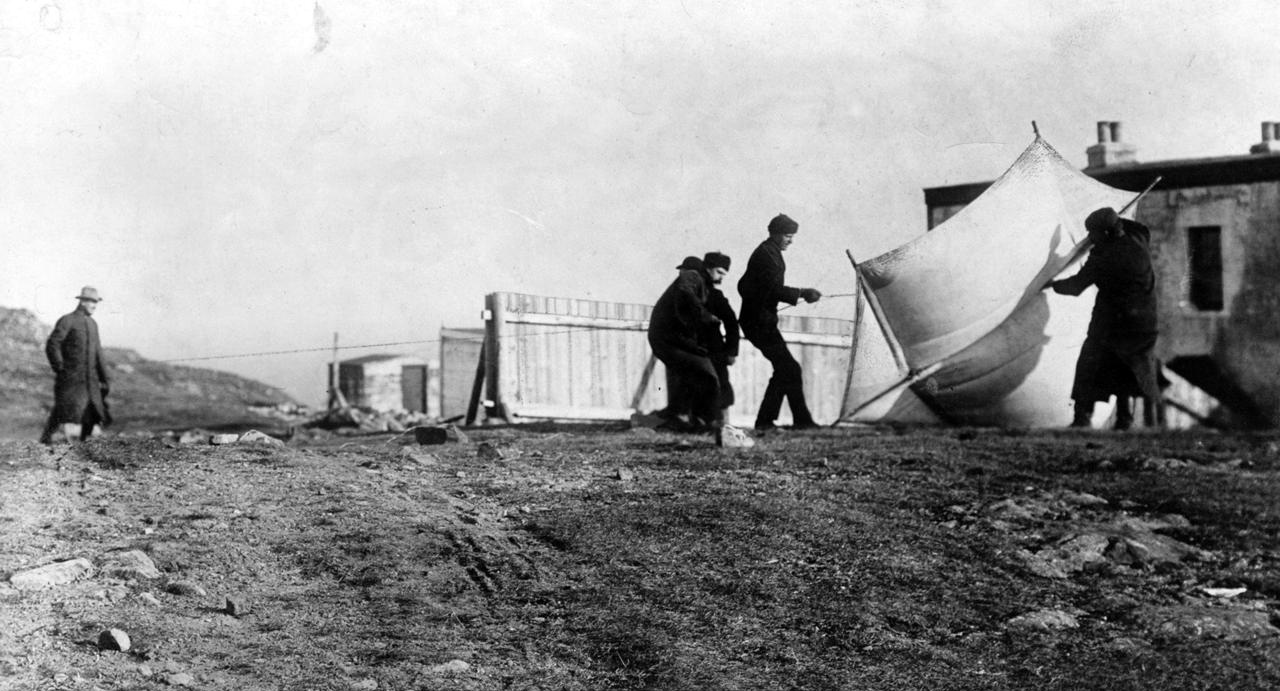
To receive the signal, he used an improvised antenna lifted by a kite. Despite technical difficulties and the doubts of his contemporaries, Marconi maintained that he clearly heard the three successive pulses that made up the Morse “S.”
The significance of this achievement was decisive. It provided the first irrefutable evidence that wireless communication could span great distances, paving the way for the subsequent development of international wireless networks, maritime communication, and ultimately, modern global telecommunications systems.
Photo:
Guglielmo Marconi and his assistants raising the receiving antenna with a kite in St. John’s, Newfoundland, December 1901. Published in the article “Marconi's Achievement” by James M. Vey in the February 1902 issue of McClure’s Magazine. (James M. Vey, Public domain, via Wikimedia Commons)