
8 February 2026 Back to News
February 8, 1930: the founding of AETE
On February 8, 1930, the Minister of Transport, Byron Karapanagiotis, signed a contract with representatives of the German company Siemens & Halske an agreement granting the company the privilege of constructing and operating the telephone network of Athens-Piraeus, and the surrounding area.
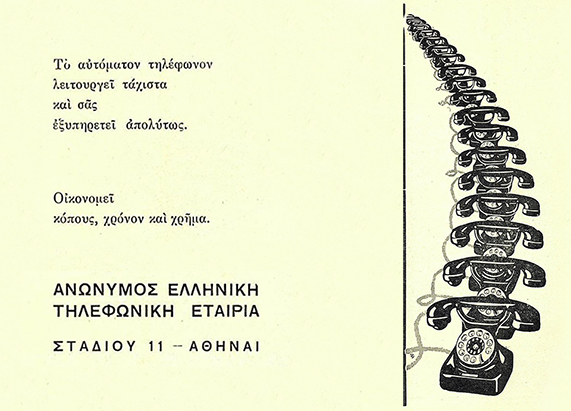
The contract was ratified on April 30 with the publication of Law 4547, which provided, among other things, for the establishment by Siemens of the Greek Telephone Company (AETE). AETE would be responsible for the development of automatic telephony within the country, while the state-owned TTT service would remain responsible for manual telephony — long-distance, international, and small towns.
On August 9 of the same year, work began on the construction of the building that would house AETE’s automatic telephone exchange. In less than a year, the work was completed and on July 31, 1931, the newly constructed building at 15 Stadiou Street was inaugurated.
During the event, attended by representatives of political, military, and religious leaders, Ioannis Drosopoulos, president of AETE and governor of the National Bank, referred to the role that the company would play in upgrading telephony in the country, noting the expansion of automatic telephony "within the next two years and to other cities in Greece." According to him, the automatic telephone service would initially serve approximately 2,800 subscribers, who until then had been connected through the manual system.
In the following years, this vision began to be realized, with AETE expanding the automatic network mainly in Athens, Piraeus, and the suburbs, gradually adding more subscribers, without, however, covering the entire country. Despite technological advances, the telephone landscape remained fragmented, with automatic and manual systems coexisting.
World War II caused serious damage to the telephone network, making its complete reconstruction necessary. In the post-war period, the Greek state now treated telecommunications as a strategic national infrastructure, inextricably linked to economic reconstruction, administrative cohesion, and national security, which led to a review of the operating status of AETE. The gradual nationalization and consolidation of scattered telecommunications operators culminated in 1949, the Greek Telecommunications Organization (OTE) was established, which took over the unified development, operation, and modernization of the national telephone network.