
10 July 2025 Back to News
Nikola Tesla / born on this day, July 10
On this day, July 10, 1856, Serbian electrical engineer and physicist Nikola Tesla was born, a modern Prometheus who led humanity into the age of electricity, while many of his approximately 700 inventions influenced the development of telecommunications.
From his student years at the Polytechnic Institute of Graz in Austria, Tesla was involved in the development of an engine using alternating current. Later, in Budapest, he envisioned the principle of the rotating magnetic field and developed plans for an induction motor, which would be the first step towards the successful utilization of alternating current.
We can see today how innovative and forward-thinking his ideas were, with alternating current being the standard for electricity supply worldwide and the induction motor being used in every electrical device.
However, at that time Tesla was unable to easily find funding for his inventions, so at the age of 28 he left Europe and traveled to New York. There he met Thomas Edison, who initially commissioned him to repair the generator of the steamship “Oregon” and then hired him in his company. However, their collaboration did not last long, as Tesla felt that he was not being paid commensurate with his contribution, while the two scientists disagreed fundamentally on the approach to electricity: Edison was a proponent of direct current, while Tesla supported alternating current.
In the years that followed, Tesla's work finally began to be recognized. With the necessary support from various financiers, in 1891 he proceeded to build the Tesla coil, which generated and amplified radio frequencies, forming the basis for the creation of the radio and later television. However, it was the Italian Guglielmo Marconi who claimed the paternity of wireless communication (radio) in 1897. Tesla claimed that Marconi had used his own patents and took legal action against him, but to no avail.
Despite his great disappointment, he returned to his laboratory determined to continue his experiments, and in 1898 he announced the invention of a remote-controlled boat, which could be described as the precursor to Wi-Fi, drones, and Bluetooth.
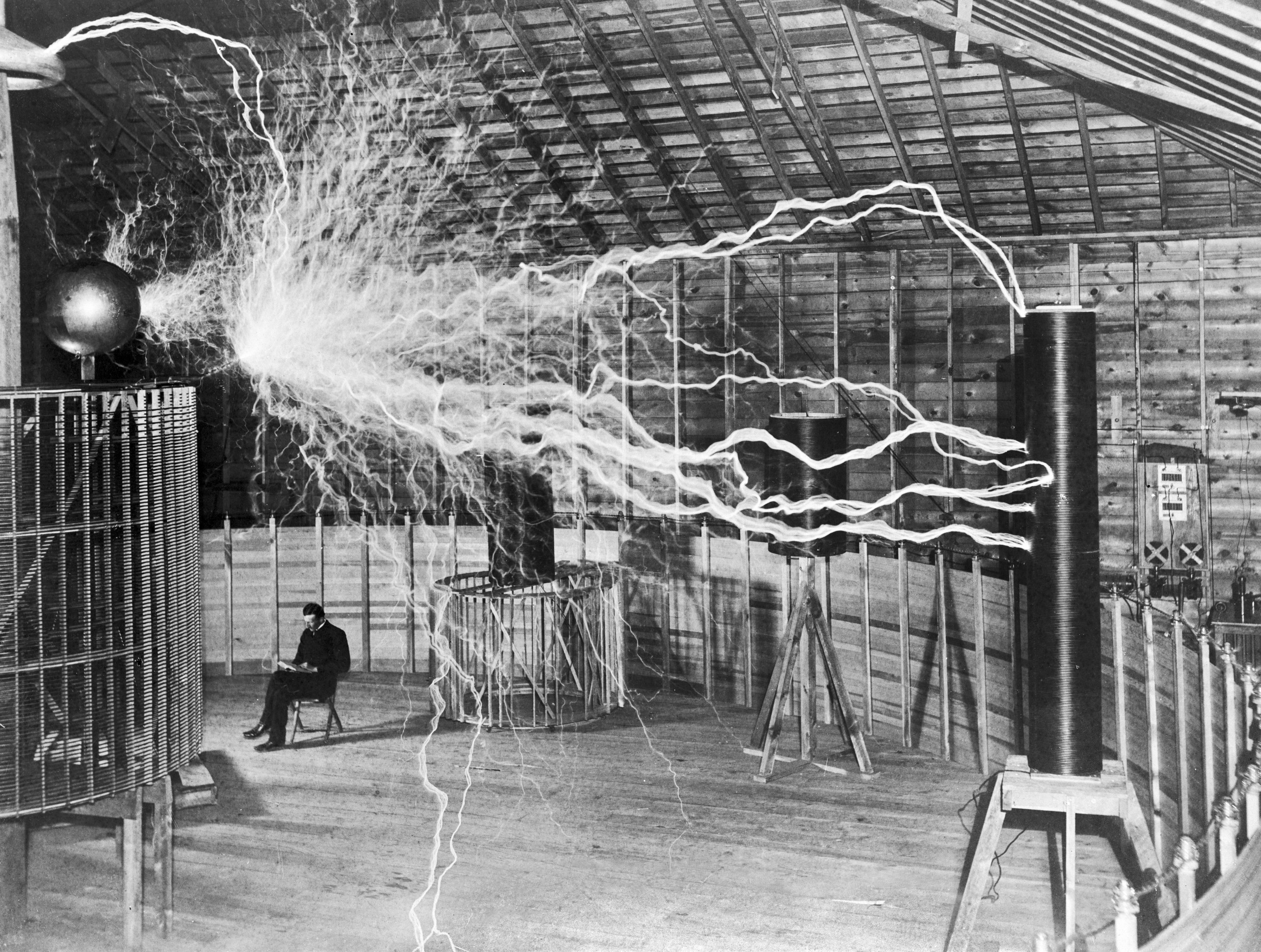
In 1899, he built a large laboratory with antennas and coils in Colorado Springs, attempting to transmit signals wirelessly over long distances. The creation of the Wardenclyffe Tower in Long Island (1901-1906) was a continuation of the previous project, and although its operation was abruptly terminated due to a lack of funding, it laid the foundations for the creation of a global wireless energy and telecommunications network, heralding the future of satellite communication.
The period from 1910 until the end of Tesla's life was marked, on the one hand, by skepticism from part of the scientific community about his theories and, on the other hand, by awards and new pioneering ideas, which, however, remained unfinished. On January 7, 1943, he died alone and penniless in New York. A few months later, the US Supreme Court ruled that Tesla was the true inventor of the radio, not Marconi, vindicating him posthumously.
Photo:
Nikola Tesla in his laboratory in Colorado Springs, December 1899, sitting and reading next to the high-voltage generator, while huge electrical discharges are produced. The photograph is the result of a technical composite of two photographs by Dickenson V. Alley: first, the sparks from the machine were photographed in a dark room, and then Tesla was photographed sitting in a chair. (Image source: Wikimedia Commons)