
13 February 2026 Back to News
Samuel Morse and Lucretia Walker: A love story that changed the History of Telecommunications
Samuel Morse has gone down in history as the inventor of the telegraph. Less well known, however, is the deep love story that marked his life and, indirectly, his very work.
In 1818 he married Lucretia Walker, with whom he had three children. Their marriage was affectionate and happy, even though it did not spring from a love at first sight, according to what he himself wrote to his parents in August 1816: “Lucretia is a woman from a good family and of considerable wealth. The latter, as you know, I have never set as my primary aim; nevertheless, it is somewhat comforting to be aware of it, given my profession [Morse was a painter]. Perhaps I flatter myself, but I think I could be a successful suitor. You may consider me a terribly rash fellow, who keeps falling in love in this way; yet I fear remaining an old bachelor, and I am already twenty-five years old.”
His love for Lucretia, however, is not a romantic myth. Letters of his have survived that reveal a man tender, emotional, and deeply attached to his wife.
In 1825, while Morse was in New York, Lucretia died suddenly at the age of 25, following complications from the birth of their third child. The letter that carried the news of her death from New Haven to New York, a distance of 112 kilometers, took four days to reach its destination. By the time Morse returned, his wife had already been buried. The fact that he did not manage to say goodbye to her deeply shocked him and marked him for the rest of his life. One month after her death, he wrote to a friend:
“You know how intense the bond that existed between my beloved Lucretia and me was. A bond that was never, even for a moment, interrupted by the slightest shadow; a bond founded, I dare say, on the purest love, and one that grew stronger day by day (…). In my beloved Lucretia I found everything I could have wished for. (…) My fear concerning the measure of my love for her was not that I might fail to ‘love her as my own flesh,’ but that I might place her in the position of Him who said: ‘You shall have no other gods before me.’ This I felt to be the greatest danger. And to be saved from this idolatry was often the subject of my sincere prayers. My whole soul was wrapped up in her. With her was bound everything I expected as happiness on earth. Is it strange, then, that I now feel this emptiness, this desolation, this loneliness, this sickness of the heart? That I feel as though my very heart has been torn from me?”
Many historians believe that this loss became a powerful psychological motivation for the search for a faster means of communication.
The great delays in the transportation methods of the time, through which correspondence was carried out (the optical telegraph was still used only for military purposes), played a role in the need the American painter felt for a new medium for transmitting messages. Seven years after Lucretia’s death, during a journey from Europe to America aboard a sailing ship which lasted nearly a month and was indicative of the speed of transportation at the time, Morse met a natural scientist who introduced him to the principles of the new science of electromagnetism. With the imagination of an artist and the substantial assistance of the engineer Alfred Vail and the chemist Leonard Gale, Morse a few years later, in 1837, invented the electric telegraph and the encoding of the alphabet into dots and dashes that bears his name. This is the world-famous Morse code. Few people, however, know that behind this invention lies the love story ‒brief and tragic though it was‒ of Morse and Lucretia Walker.
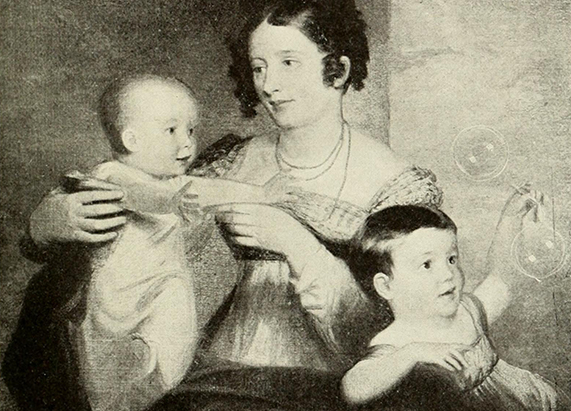
Photo:
Lucretia Walker, painted by Samuel Morse. (By Internet Archive Book Images — https://commons.wikimedia.org/w/index.php?curid=43998645)