

6 March 2026 Back to News
150 years since the invention of the telephone
March 7, 1876 is a landmark date in the history of telecommunications, as on that day Alexander Graham Bell officially secured the patent for the telephone in the United States. The patent, numbered 174,465, was titled “Improvements in Telegraphy” and did not mention anywhere the words “telephone” or “speech.”
A Scotsman in Boston
Bell (1847-1922), born in Scotland, was neither an engineer nor a physicist. He came from a family of elocution teachers, and he himself followed his father’s profession. The death of his two brothers from tuberculosis within a period of three years prompted the Bell family to emigrate in 1870 from the polluted and unhealthy atmosphere of industrial London to the clean air of sparsely populated Canada. The following year Bell moved to Boston, where he taught innovative methods of speech at a special school for the deaf. In 1872 he began experiments on transmitting sounds through telegraph lines. His knowledge of electricity was limited, and in 1875 he began collaborating with the engineer Thomas A. Watson. In March of the same year he visited the physicist Joseph Henry at the Smithsonian Institution, who showed him the “telephon,” a device for transmitting sound through electricity that had been invented by the German Philipp Reis in 1861. Henry encouraged Bell to abandon his experiments on the multiple telegraph and focus on research into the transmission of sound. When Bell replied that he lacked the necessary knowledge, Henry answered: “Get it!”
The decisive breakthrough occurred by chance on June 2, 1875, when Watson, while attempting to repair a telegraph, accidentally transmitted a metallic sound to another room. Bell then realized that in order for sound to be transmitted through telegraph lines, the electric current had to be continuous and pulsating, “imitating” the vibration of sound rather than being intermittent as in the telegraph. This invention, which was officially secured with a patent on March 7, 1876, could not yet transmit the human voice. To achieve that, Bell had to experiment with a liquid transmitter, an idea he likely “borrowed” from his rival inventor Elisha Gray.
One Invention, Many Contenders
In discussions about the birth of telephony, several names are often involved, each claiming a role in the invention. Among them is the Frenchman Charles Bourseul, a telegraph technician who in 1854 proposed to the French Academy of Sciences the transmission of voice through electrical signals. Around the same time, Antonio Meucci, an Italian immigrant in the United States, constructed the “telettrofono,” a device capable of transmitting the human voice electrically, and in 1871 he filed a patent application in the U.S. As mentioned earlier, in 1861 Philipp Reis in Frankfurt presented the “telephon,” the device that Joseph Henry later showed to Bell. Finally, there was Elisha Gray, who submitted a patent application on the same day as Bell ‒February 14, 1876‒ and whose experiments the Scottish inventor likely knew about.
The idea that “there is no single, unique inventor,” but that technological innovations are the result of collective and cumulative processes, is a central view in modern historiography of technology. The success of a technology depends not only on the original invention but also on the social environment that makes it functional and economically viable. The name Alexander Graham Bell ultimately prevailed because of the successful patent registration in 1876 and the commercial exploitation of the invention. Moreover, Bell’s father-in-law and financial backer, Gardiner Greene Hubbard, was the most prominent patent lawyer in Boston at the time.
However, we observe that in every technological achievement the human factor also plays a role. Bell had developed a deep connection with people who lived in silence. His mother gradually lost her hearing when he was still a child, and he would place his lips close to her forehead so that she could “feel” the vibrations of his voice. Later he became a teacher of the deaf and fell in love with one of his students, Mabel Gardiner Hubbard, who had lost her hearing at the age of five due to scarlet fever. When Bell’s financial backers pressured him to devote himself to multiple telegraph, he chose instead to focus on the transmission of speech. His invention was not driven solely by the pursuit of financial gain or scientific recognition, but also by a passion to help people who could not communicate through speech. His life suggests that technological innovation is shaped not only by institutions and scientific paradigms, but also by personal experiences, values, and emotions.
Photos:
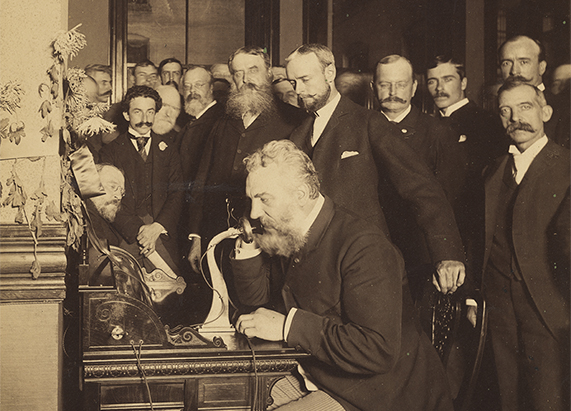
- Alexander Graham Bell at the inauguration of the New York–Chicago long-distance telephone line in 1892.
- The evolution of telephone devices at the Telecommunications Museum of the OTE Group.