
23 June 2026 Back to News
June 23 – World Olympic Day: Greece’s presence in the Museum’s photographs
With the central message “You Can Do This! – Let’s Move”, the International Olympic Committee invites people of all ages to celebrate Olympic Day again this year on June 23, offering opportunities for sports and play through more than 150 activities and events taking place around the world.
World Olympic Day is dedicated to the Olympic ideal and was established to be celebrated on June 23, the anniversary of the founding of the International Olympic Committee in 1894 and the decision to hold the first modern Olympic Games in Athens in 1896.
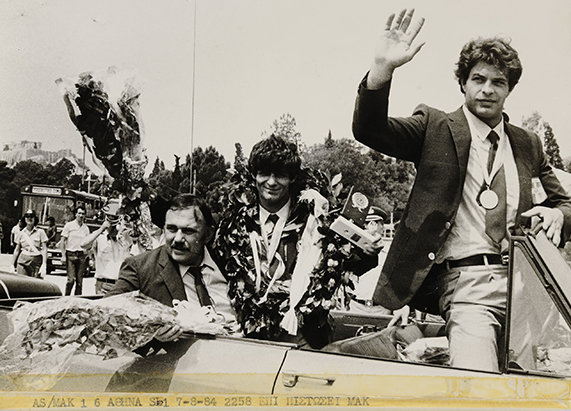
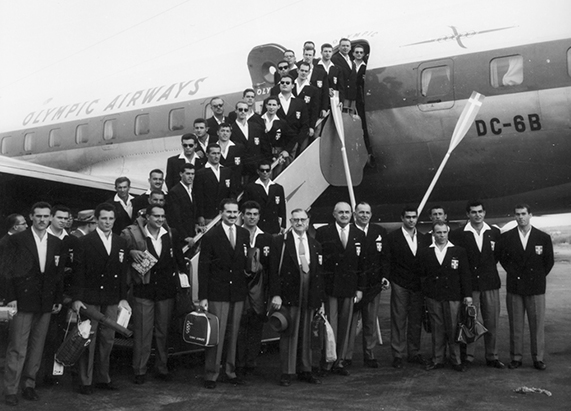
To mark World Olympic Day, the Museum is presenting two photographs (Floros Brothers Archive – Nikos L. Floros) from its collections that capture different moments of Greece’s participation in the Olympic Games.
The first photograph, dated August 7, 1984, shows Greco-Roman wrestlers Babis Holidis and Dimitris Thanopoulos upon their return to Greece from the Los Angeles Olympic Games. Dimitris Thanopoulos, standing on the right, won the silver medal in the 82-kilogram weight class in his second Olympic appearance, while Babis Holidis, seated next to him, won the bronze medal in the 57-kilogram weight class. For Holidis, this was his second Olympic medal, as he had also won bronze at the 1980 Moscow Olympics.
The 1984 Olympics were marked by the intense Cold War atmosphere of the time, as the Soviet Union and most of the Eastern Bloc countries boycotted the event, while Greece was represented by 62 athletes.
The second photograph captures the departure of the Greek Olympic team from Elliniko Airport bound for Rome, where the 1960 Olympic Games were to be held. The Greek delegation consisted of 48 athletes, who competed in eight sports, while the flag bearer was the heir to the throne, Constantine. Constantine won the gold medal in sailing (Dragon class), with Odysseas Eskitzoglou and Georgios Zaimis as his crew. This medal was the only one won by the Greek delegation.
The Rome Games marked a new era for the Olympic movement, as they were the first to be extensively covered by television on an international level. At the same time, many events were held at historic sites throughout the Italian capital, creating a symbolic link between classical antiquity and modern sports.