
29 July 2026 Back to News
Mikis Theodorakis through the lens of the Museum
On July 29, 1925, Mikis Theodorakis, one of the most important figures in 20th-century Greek culture, was born on Chios. A composer, writer, and politician, his name became synonymous with the renewal of Greek music, while his work was closely linked to the struggles for democracy, freedom, and social justice.
He grew up in various cities across Greece due to his father’s job transfers and devoted himself to music from a young age. At just 17 years old, he gave his first concert in Tripoli, performing the work “Kassiani.”
During the Occupation, he joined the National Resistance and was subjected to arrests, torture, and exile. He faced similar persecution after the Civil War as well, culminating in his imprisonment and exile during the Colonels’ dictatorship. In 1970, thanks in part to the efforts of international figures, he was released from prison and settled in Paris, where he became actively involved in the anti-dictatorship movement.
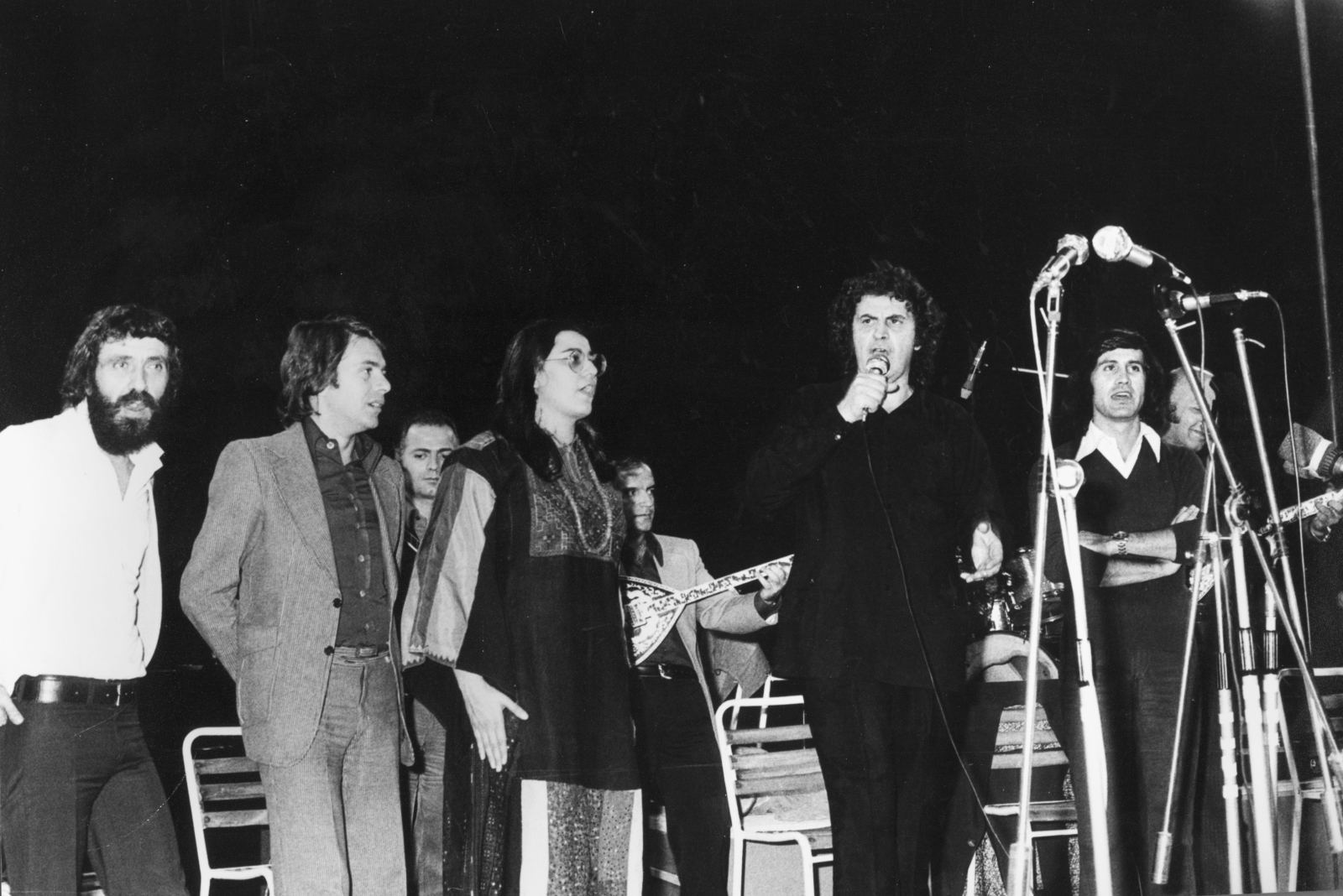
After the restoration of democracy, he returned to Greece. His music could now be heard freely, and his concerts became massive events, with thousands of people flooding the stadiums. The main performers of his songs during that period were Maria Farantouri, Antonis Kalogiannis, and Giorgos Dalaras.
His compositional work ranges from symphonic music and opera to chamber music, oratorio, and folk songs. He set the works of leading Greek poets ‒such as Yannis Ritsos, Odysseas Elytis, and Giorgos Seferis‒ to music, playing a decisive role in bringing poetry to a wider audience. Among his major works ‒which stand as milestones in Greek music‒ the following stand out: “Axion Esti,” “Romiosini,” “Epitaphios,” “Canto General,” “Mauthausen,” and others.
The music he composed for film ‒most notably for the movie “Alexis Zorbas” (1964)‒ established his international reputation. He was honored with major international awards, such as the Gold Medal for Composition at the Moscow World Festival of Youth (1957), the BAFTA Award for the music of the film “Z” (1970), and the UNESCO International Music Prize (2005); in 2000, he was nominated for the Nobel Peace Prize.
Beyond his artistic career, he maintained a strong public presence until the end of his life, participating in initiatives for peace, human rights, and national issues, and served as a member of parliament and a minister, pursuing one of the most multifaceted political careers in modern Greece. He passed away on September 2, 2021, leaving behind an invaluable musical legacy. As he himself said, “I divided my life between music and the struggle for humanity.”
Photos from left (Floros Brothers Archive – Nikos L. Floros):
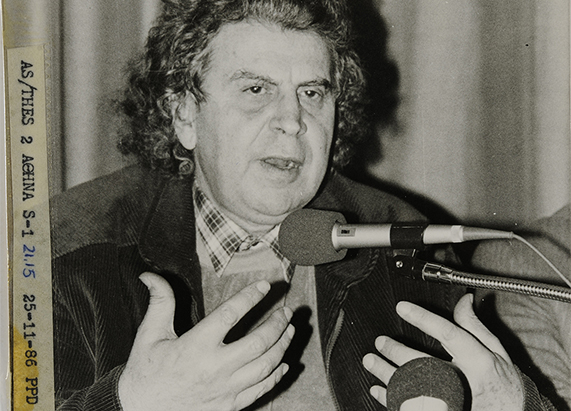
- Mikis Theodorakis during a press conference on November 25, 1986, at the Foreign Press Correspondents’ Association, where he spoke primarily about the issue of the military regime in Turkey.
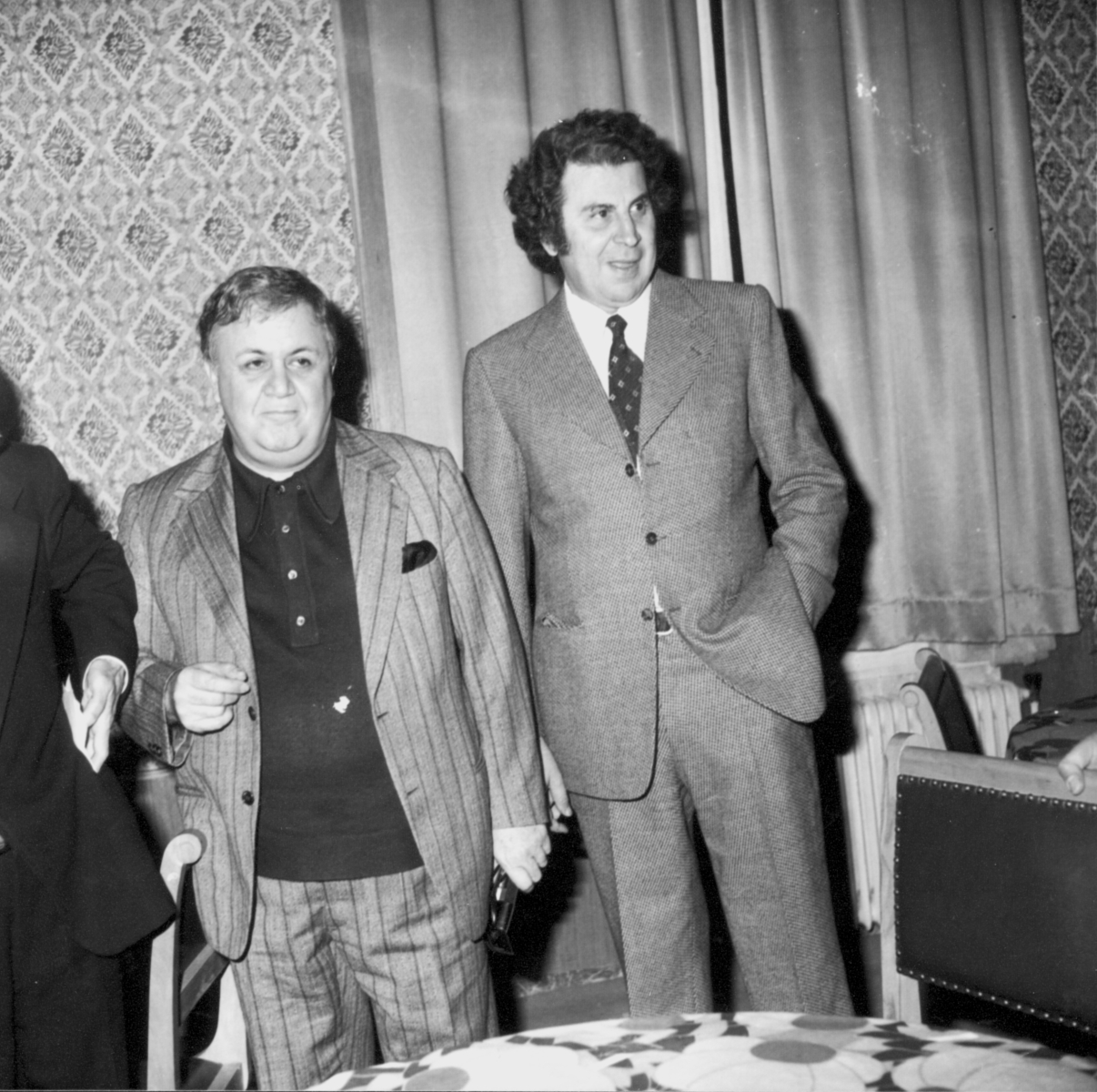
- Alongside Manos Hadjidakis. Despite their different musical paths and their occasionally divergent political views, the two great composers maintained a relationship of mutual appreciation and respect.
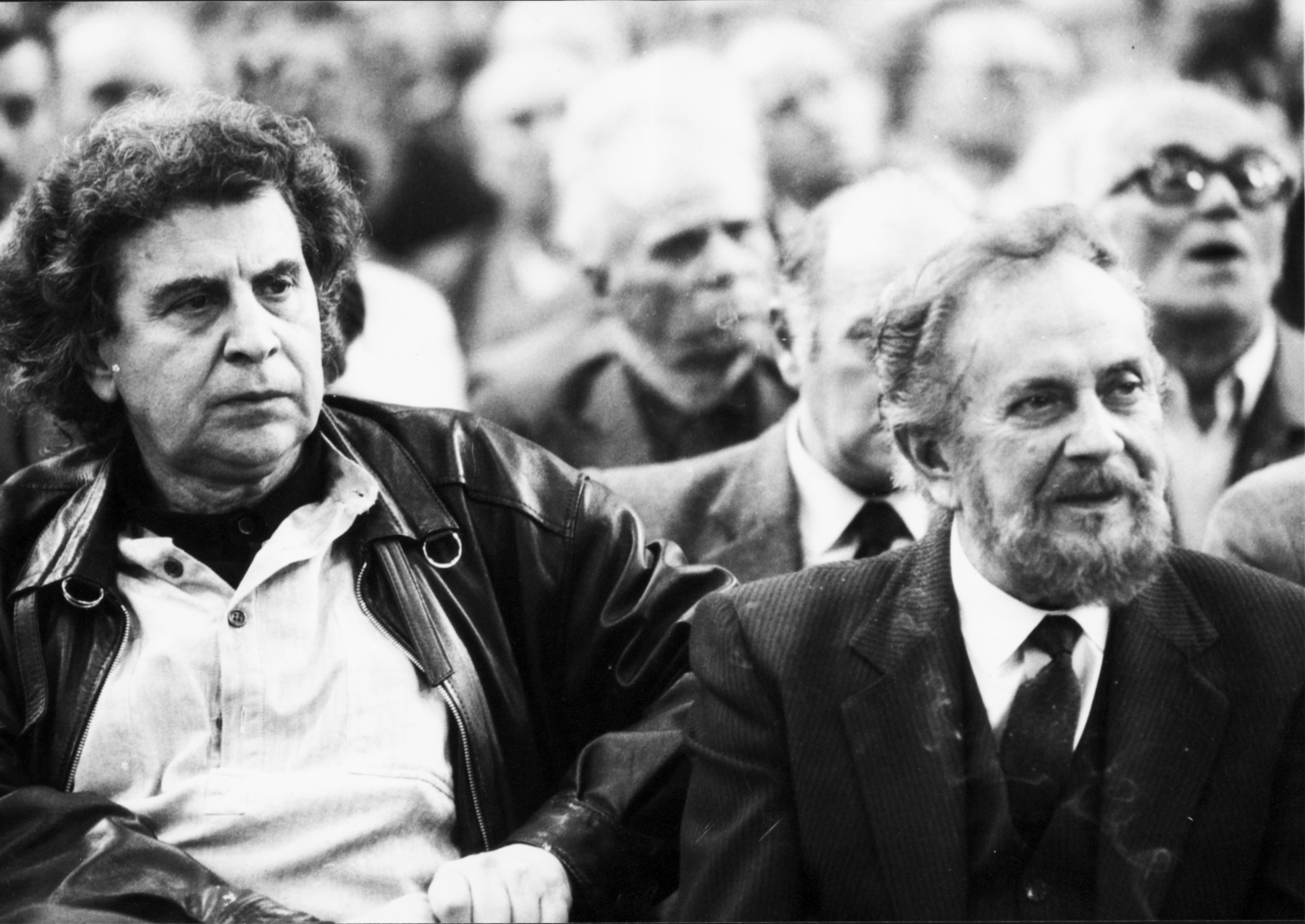
- With the poet Yannis Ritsos. Theodorakis’s setting of “Epitaph” to music marked his shift toward folk music.
- A snapshot from the first concert Mikis Theodorakis gave after the fall of the junta, in October 1974, at Karaiskakis Stadium. Visible from left to right are Antonis Kalogiannis, Petros Pandis, Maria Farantouri, and, to the composer’s right, Giorgos Dalaras.