In the 1968 film Humble and Despised, the protagonist, Nikos Xanthopoulos, arrives in Athens from the provinces. Feeling lost in the big city, he meets a young shoeshine boy, Vasilakis Kailas, on the street, and the following exchange takes place in front of a kiosk:
— Come on, mister, let me start the day with my first customer.
— I’ll give you half a fifty-drachma note if you tell me how I can find someone whose address I don’t know. His name is Lakis Anastopoulos.
— Easy, very easy — with the telephone directory. You’ll go through all the Anastopouloses and you’ll find him.
— Help me make the phone call, because I’ve never even opened a primer.
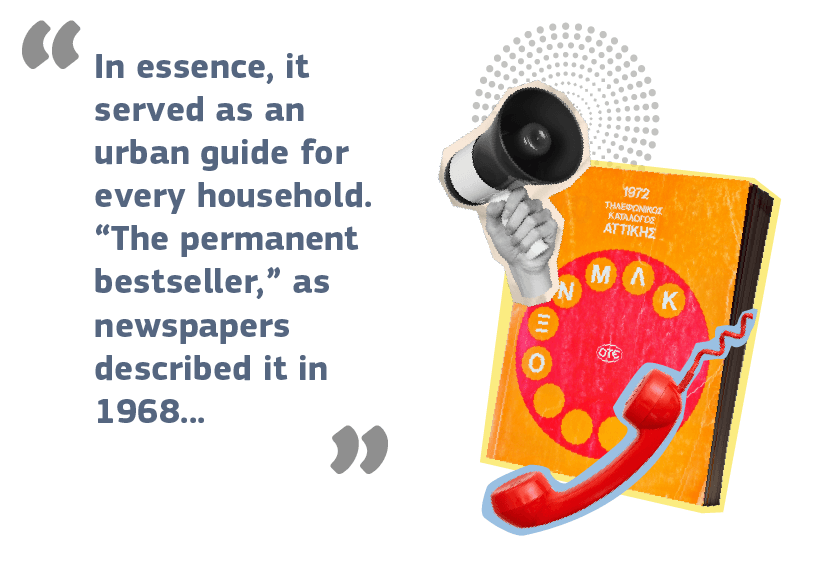
Despite the film’s naïveté, the dialogue is indicative of the place held by OTE’s telephone directory in Greek society. In essence, it served as an urban guide for every household. “The permanent bestseller,” as newspapers described it in 1968:
“With each new edition, the telephone directory is leafed through with interest because it contains information that not only impresses but also reveals. One realizes just how indispensable the telephone has become today (…). For an airplane to unroll the paper used to print the new directory, it would have to circle the Earth’s Equator one and a half times.” In other words, each new edition of the telephone directory was almost a small ecological disaster, caused by a book that everyone had at home and that had to be reprinted every year, as the number of subscribers was constantly changing.
“Speak clearly and in a low voice.”
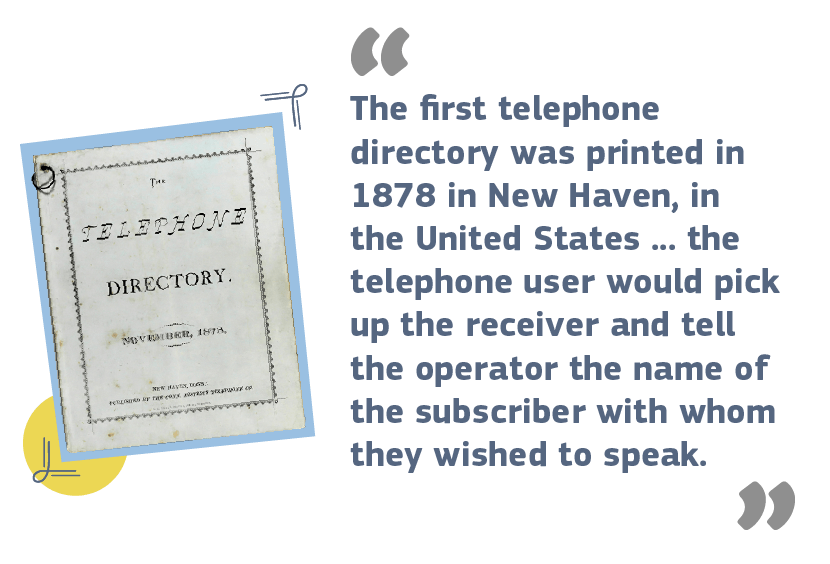
The first telephone directory was printed in 1878 in New Haven, in the United States, by the local telephone company. It consisted of a single page, contained 50 names in non-alphabetical order, and included no telephone numbers. The directory existed mainly to inform subscribers of the identity of the other telephone owners. Since automatic telephony had not yet been invented, the telephone user would pick up the receiver and tell the operator the name of the subscriber with whom they wished to speak. Numbers were not necessary.
In Greece, the first standalone telephone directory was printed in 1911 by D. Terzopoulos and contained 967 subscribers. In the opening pages of the directories from this early period, there were instructions on the proper use of the telephone, such as:“It is absolutely necessary, when conversing, to stand directly opposite the microphone and at a distance of 5 centimetres from it.” There were also recommendations urging subscribers not to ask the telephone operators pointless questions, such as “Who is there?”
A significant historical source
In 2001, almost a century after the publication of the first telephone directory in Greece, the Yellow Pages, OTE’s professional directory, went digital. With the spread of digital and online services, the era of printed subscriber directories came to an end. Today, however, these books can be read not simply as obsolete objects from the past, but as historical documents recording the diffusion of technology into everyday life. They also make visible patterns of urbanization, commercial geography, and class and gender differentiation.
In the 1925 telephone directory of mainland Greece, among the 2,359 subscribers in Athens, there were only 40 women, some of them famous figures such as Marika Kotopouli and Louisa Riancour. Telephony was still a male affair. In Thessaloniki, 23% of subscribers had Jewish names, an indication of the high proportion of the city’s Jewish population before the Holocaust. In Athens, only 28% of the numbers corresponded to households. The remaining subscribers were professionals — mainly doctors and lawyers — as well as companies, shops, offices, especially stockbroking firms, and public services. Together with its numerous advertising entries, the 1925 telephone directory looked more like a professional guide to Greece, or a map of the upper middle class. To “be in the directory” meant being socially recognizable and commercially accessible.
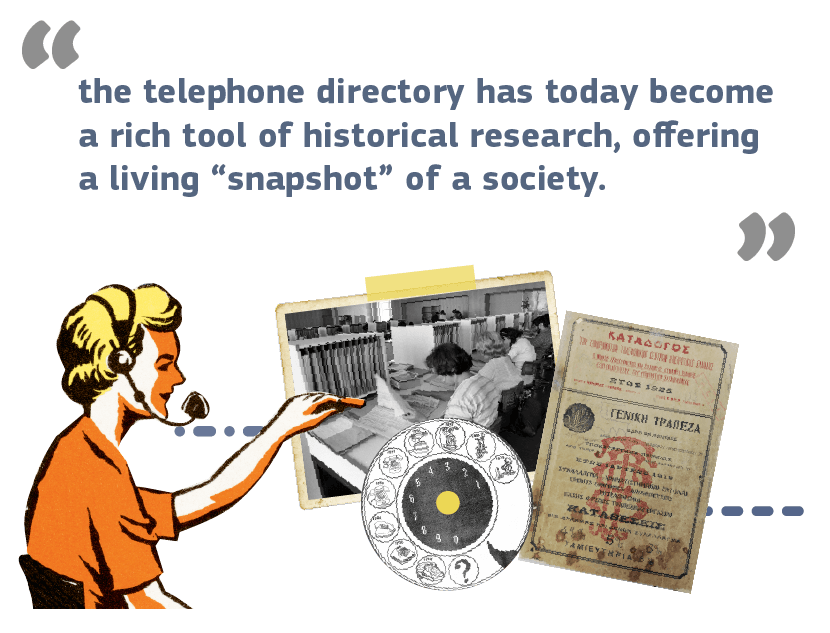
Thus, from a simple, practical object of the past, the telephone directory has today become a rich tool of historical research, offering a living “snapshot” of a society.