The invention of the electric telegraph in the 1840s created new expectations for faster communication. Although the telegraph virtually eliminated time and space, as messages could now travel at unprecedented speed, once a telegram arrived at the telegraph office it was up to the messenger to deliver it to the final recipient using the traditional method employed even by the couriers of antiquity: on foot. As telegraphic traffic grew, so did the delivery time of telegrams. Moreover, considering that in London in 1850, 80% of telegrams concerned the stock exchange and business matters, we understand that the telegraph was closely linked to the transmission of time-sensitive information.
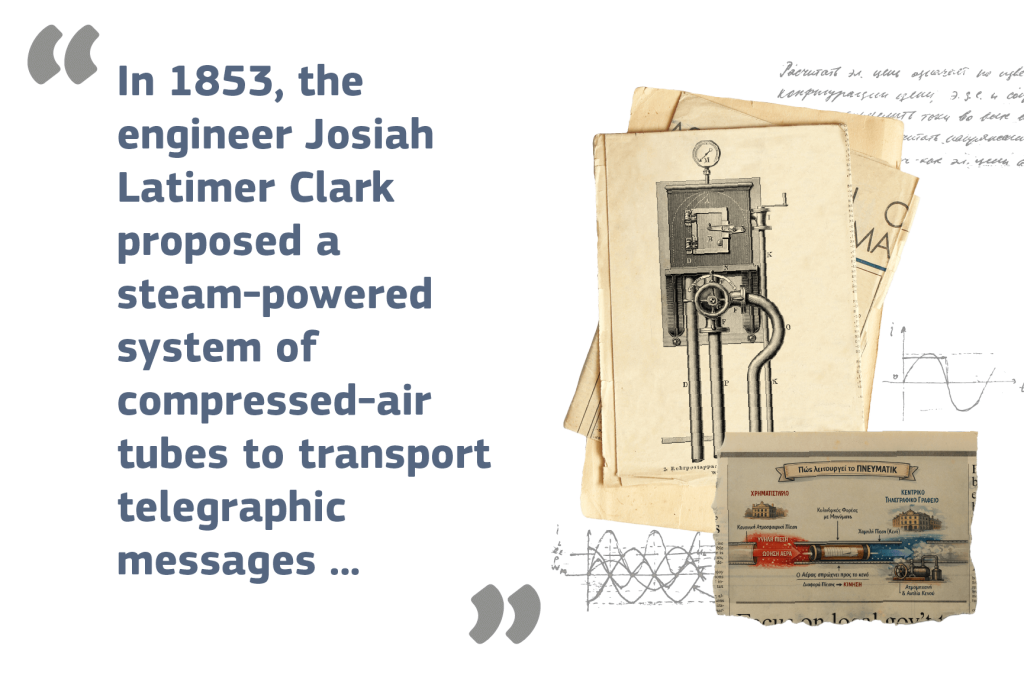
In 1853, the engineer Josiah Latimer Clark proposed a steam-powered system of compressed-air tubes to transport telegraphic messages over the short distance from the Stock Exchange to London’s Central Telegraph Office. These tubes were called “pneumatic,” since the ancient Greek word pneuma means, among other things, the blowing of the wind. In Greece, this message-transport system was translated somewhat awkwardly as “tube mail”, while in everyday language the French term pneumatique ultimately prevailed.
Operation and Expansion of the Pneumatique
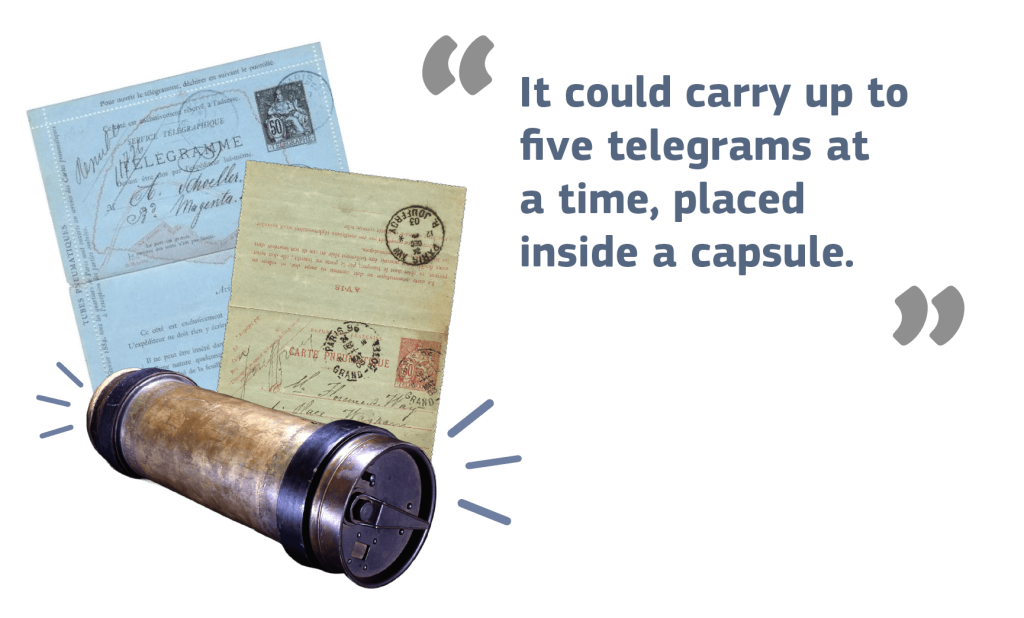
Clark installed an airtight tube, 4 centimeters in diameter, underground between the two telegraph stations. It could carry up to five telegrams at a time, placed inside a capsule. A steam engine in the basement of the Central Telegraph Office created a partial vacuum in front of the capsule. Due to the difference in pressure, the air pushed the capsule toward the vacuum, and it took about half a minute for each one to be drawn through the tube. This system was much faster than sending messages via telegraph, which could transmit only one message per minute. The success of the pneumatique was considerable. By 1865, the increase in telegraphic traffic led the Electric Telegraph Company to expand the London network and install similar systems in Liverpool, Birmingham, and Manchester. Very soon, the pneumatique was adopted by many European cities.
A Parisian Story
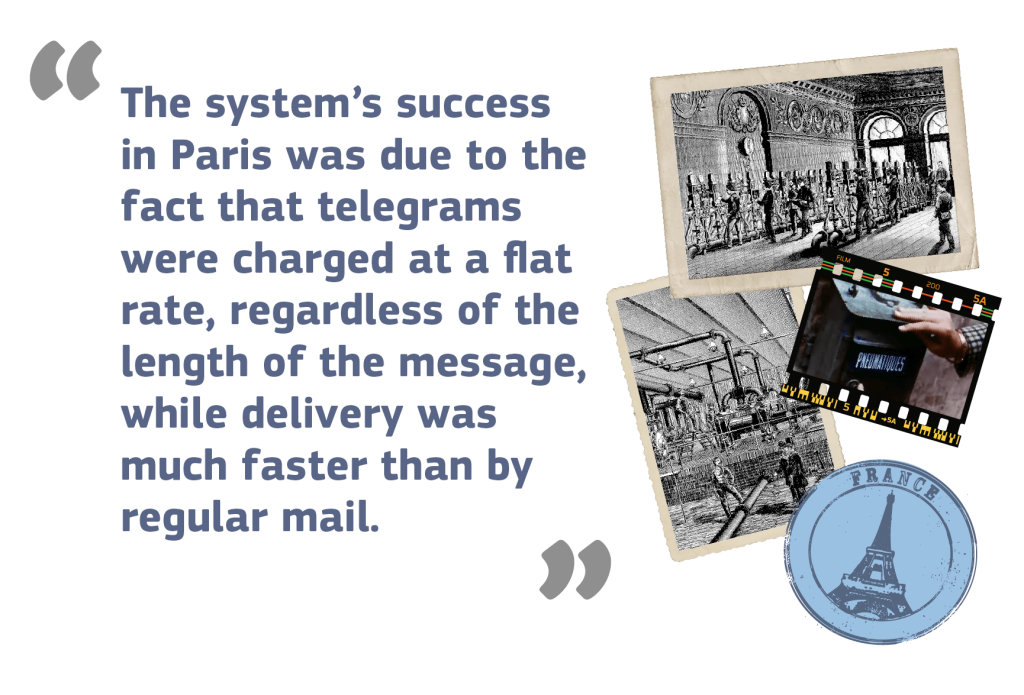
Of all the pneumatic tube networks built worldwide, the most successful was that of Paris, where sending and receiving messages via the pneumatique became part of everyday life until the 1960s. In Jean-Luc Godard’s film Breathless (1960), a journalist recounts the story of a romantic exchange between a couple conducted through the pneumatique. The system’s success in Paris was due to the fact that telegrams were charged at a flat rate, regardless of the length of the message, while delivery was much faster than by regular mail. Parisians would drop their telegrams into small boxes, similar to mailboxes, placed at various points throughout the city. The messages were then taken to the nearest telegraph office and, via the pneumatique, distributed to any part of the city and its suburbs within minutes, since operating the tube system did not require a specialized telegraph operator.
The Pneumatique in Greece
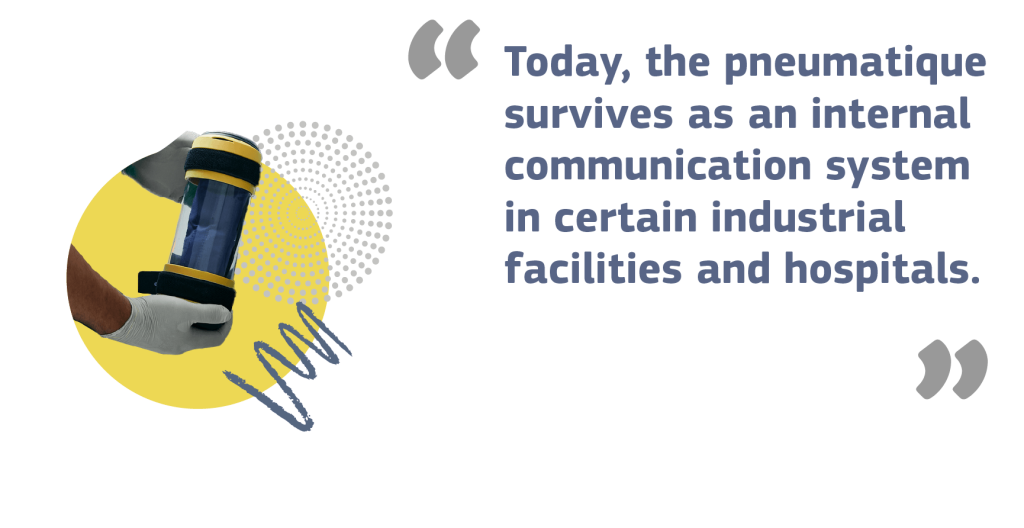
The pneumatic tube system was installed in 1958 by OTE (the Hellenic Telecommunications Organization) exclusively to serve the administrative buildings of YMA–Kratinou–Omonia & Stadiou, ensuring the transmission of telegrams and various documents. It was never used in Greece for communication by the general public. In any case, the era of the pneumatique had already passed, as from the 1950s onward the service gradually began to shut down across Europe. The widespread postwar adoption of the telephone and the teletype, along with the difficulty of maintaining the network of tubes, made the pneumatique economically unviable. In terms of mentality, tube mail became associated with outdated forms of workplace automation. Terry Gilliam’s film Brazil (1985) depicts a government building filled with pneumatique systems, symbolizing the absurdity of bureaucracy and the oppressive nature of “futuristic” technology. Today, the pneumatique survives as an internal communication system in certain industrial facilities and hospitals.
In the digital age, with vast volumes of data transmitted in seconds and the seemingly immaterial nature of telecommunications, tube mail appears to be an obsolete technology. In Greece especially, few people are aware that such a system ever existed—even if they have noticed, in a hospital for example, tubes running along the walls with strange sounds and plastic capsules emerging from them. Certainly, even those who use these internal communication systems today can hardly imagine that this invention was once described as a “technology of the future.”